The practical stuff, answered once so you do not have to read six blog posts. Everything here is written for someone staying in El Poblado — near the malls, the pharmacies and the airport road — and reflects the way the city actually works rather than the way guidebooks assume it does.
Money
Colombia uses the peso (COP). Exchange rates move, but for rough mental arithmetic there have been a few thousand pesos to the US dollar for years — check the day’s rate before you land. Prices are quoted in full (“cuarenta mil” — 40,000 — for a cocktail), and the number of zeros takes a day to stop being alarming.
- Cards are accepted almost everywhere in El Poblado, including small cafés. Tap-to-pay is common.
- Cash is needed for street food, small tips, some taxis and the market. Withdraw from ATMs inside malls or bank branches by day; avoid street ATMs at night.
- ATM limits per withdrawal are often modest; you may need two transactions for a larger sum.
Tipping
Restaurants add a voluntary 10% service charge (“propina voluntaria”) and the server will ask, “¿Incluye la propina?” Saying yes is the norm; you can decline. Beyond that, tipping is light: round up taxis, a few thousand pesos for hotel porters, and cash for tour guides if they were good (COP 20,000–50,000 is generous for a group tour). Bar staff do not expect tips per drink.
SIM cards and eSIM
The big carriers are Claro (best coverage outside cities), Movistar and Tigo (both strong in Medellín), and budget WOM. Buy at the airport if you must, but the carrier stores and kiosks in the Oviedo, Santafé and El Tesoro malls are cheaper and calmer. Bring your passport. A tourist plan with plenty of data costs the equivalent of a few dollars to a few tens of dollars depending on the bundle. Most modern phones can instead use an eSIM bought before you fly — convenient, usually pricier per gigabyte.
Weather and when to come
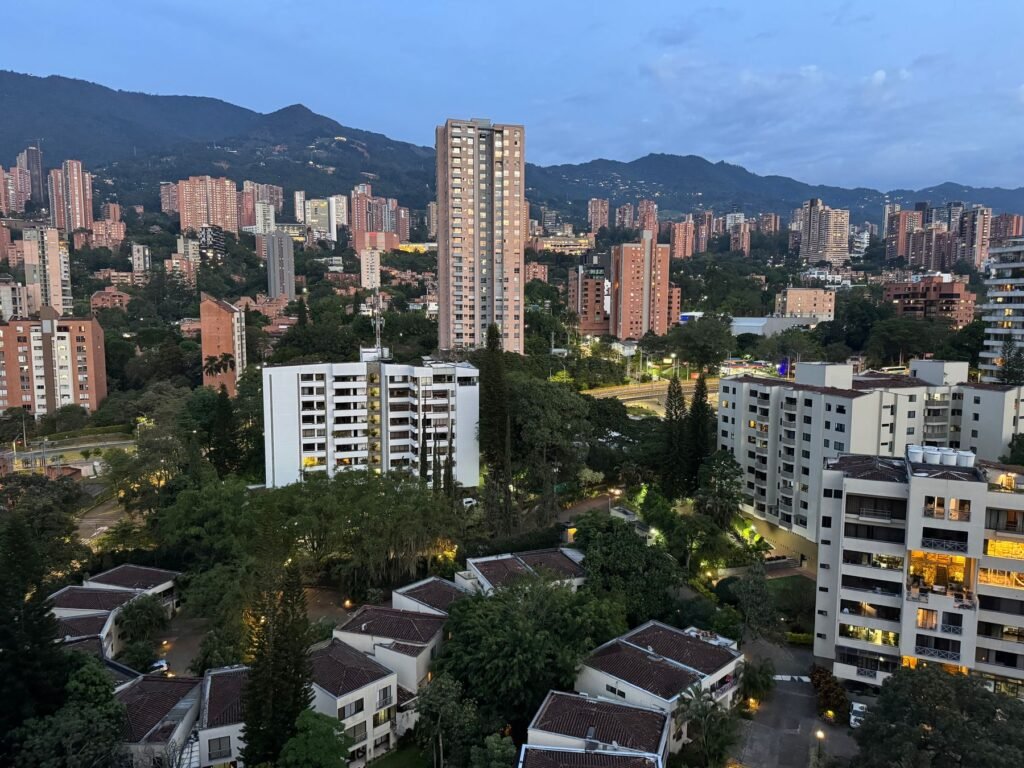
Medellín is the “City of Eternal Spring” and the nickname is earned: the city sits at about 1,495 m and the temperature hovers around 22–27°C year-round, with no real seasons. What changes is rain. The wetter periods are roughly April–May and September–November, when afternoons often bring a heavy shower; December to February and July–August are the drier months. Rain rarely lasts all day, and a light jacket plus a small umbrella covers it.
Two events shape the calendar. The Feria de las Flores in early August fills the city with parades, concerts and the silletero flower-carriers of Santa Elena — book hotels early. The Alumbrados, the Christmas lights, run through December and turn the riverfront and parks into a nightly event. Parque Lleras itself is busiest on any Thursday to Saturday and over Colombian long weekends (“puentes”).
Tap water
Safe to drink. Medellín’s water is treated by EPM, the city utility, and locals drink it from the tap; ice in restaurants is fine. If you prefer bottled for taste, every corner shop sells it.
Plugs and power
Type A and B sockets (the North American two- and three-pin), 110 V, 60 Hz. Travellers from the US and Canada need nothing; everyone else needs a plug adapter, and check that chargers accept 110 V (almost all phone and laptop chargers do).
Altitude
At around 1,495 m Medellín is high enough to notice on the first climb up from the Metro, and not high enough to cause real altitude sickness. Drink water, take the hills slowly on day one, and go easy on the first night’s aguardiente.
Spanish
English is common in El Poblado’s hotels, better restaurants and tour companies, and rare outside them. A few phrases go a long way: buenas (the all-purpose greeting), ¿cuánto cuesta? (how much), la cuenta, por favor (the bill), no, gracias (for street vendors and offers you do not want), ¿habla inglés?. Paisa Spanish has its own music — ¿qué más, pues? for “how’s it going” and parcero for friend — and people will be pleased if you try.
Local habits worth knowing
- “No dar papaya.” Literally “don’t give papaya” — don’t make yourself an easy target. The single most repeated piece of local advice; it covers phones, jewellery, drunkenness and wandering. See the safety guide.
- Time. Dinner is 7–9 pm, nightlife starts late, and “ahorita” means somewhere between now and never.
- Escobar. Many paisas find the tourist fascination painful. Ask about the city’s transformation instead; you will get a better conversation.
- Aguardiente. The anise-flavoured national spirit, drunk in shots at every celebration. It is stronger than it tastes.
Health and pharmacies
Pharmacies (droguerías) are everywhere in El Poblado and many are open late; pharmacists can advise on minor problems. Private clinics in the district are good and used to foreign patients; travel insurance is strongly recommended. Sunscreen matters more than the mild temperatures suggest — you are near the equator and at altitude.
Frequently asked questions
What is the best time to visit Parque Lleras?
Any time of year works for the weather. For drier days, December–February and July–August; for the Feria de las Flores, early August; for the Christmas lights, December. Thursday to Saturday for the nightlife.
Can I pay by card in El Poblado?
Almost everywhere, including cafés and taxis booked through apps. Carry some cash for street food, tips and the odd taxi.
Do I need a visa for Colombia?
Citizens of the US, UK, EU, Canada, Australia and many other countries get 90 days on arrival without a visa; check your own government’s guidance before you travel, as rules change.
Is Medellín expensive?
By North American or European standards, no. El Poblado is the city’s priciest district and a good dinner, cocktails and a taxi home still cost a fraction of the same night at home.
One email with the short version — where to stay near the park, what to book first, and the safety habits that matter. No spam, unsubscribe any time.